Saturday, December 29, 2012

Dare Me by Megan Abbott: A Review

Dare MeDare Me by Megan Abbott
My rating: 4 of 5 stars

What a brilliant though nearly indescribable book. (There is simply no good way to explain how a book about cheerleaders and murder can be lyrical and beautiful, but it is.)

This is the story of the friendship between Addy Hanlon and Beth Cassidy, two high school cheerleaders at the top of their game. But when a new coach is hired to lead them, the delicate pyramid of power is disrupted, and the consequences are deadly.

I loved this book. The writing is gorgeous. It is visceral and magical and raw. Abbott perfectly captures the evils of adolescent self-absorption and cruelty in these characters in pitch-perfect prose.

I keep describing this to friends as the literary equivalent of the film "Heathers," but it's so much better even than that.

Read this!

Monday, December 17, 2012

For the Sisters and Brothers

My first reaction to the tragedy at Sandy Hook Elementary School on Friday was as a mother. Outrage and fear and pure agonizing sorrow have settled somewhere in the depths of my marrow over the last few days. But my next reaction comes as someone who at a very young age lost two siblings. This is for the surviving brothers and sisters.

When I was ten years old, my mother gave birth to twin girls: Jillian and Miranda. They were unplanned and unexpected as well. (In 1979, doctors did not routinely conduct ultrasounds, and so when my mother went into labor a month early and Jillian was born, the doctor was baffled at her small size until he realized she had a twin still waiting to be born.) And so, ready or not, our family of four grew quickly into a family of six.

The twins were premature, and they were born in a rural hospital that did not have the sophisticated NICU wards of today's facilities. They were in the hospital for an entire month before they were allowed to come home. However, despite the lack of access to neonatal specialists, they seemed to have made it past the initial hurdles of being born too small (just about 3 and 4 pounds each respectively). And their lives felt like gifts.

Soon, however, it became evident that they had health issues that transcended their being born prematurely. The phrase I remember being used again and again by the doctors was "failure to thrive." This meant they did not eat, and they did not grow, and they did not develop as they should. By the following summer, they were both very ill. They had respiratory issues, cardiac issues, and something called "lactic acidosis" which rendered them in a constant state of pain.

We spent the entire summer commuting between our home and a larger hospital an hour away. The doctors were mystified, and could offer us little hope. And when Jillian passed away that June, we all feared for her identical twin's fate.

But I was eleven then, and I believed in the power of magical thinking. I believed that if I prayed hard enough, if I bargained with God, if I promised any number of little girl promises, that Miranda would survive. And so when she died that August, I was devastated. I was angry with the universe. I was angry with God. And I felt utterly powerless. (I can only imagine what my mother and father felt. And as a mother now, I wonder at the grace with which they handled this theft. I know now, this was their gift to me and my younger sister and I am so, so grateful.)

When school started again, I channeled this frustration and sorrow into writing. I wrote the story of this loss again and again and again. (I believe sometimes that I am still writing that story with every novel I write.)

Writing gave me control. It put me in charge in a situation where no one was in charge. It empowered me. And it conjured them; it brought them back, at least in my imagination.

On Saturday, I wrote 9,000 words. I turned off the television and (when I wasn't hugging my own daughters) I wrote. And wrote. I was manic. Mad even, pounding out a story that had nothing to do with the reality of what happened in Connecticut on Friday. I was eleven years old again, trying desperately to create a world in which children do not die. In which little girls will not grow up without their sisters.

All I have, all I have ever had, are my words, but now they seem to fail me. Because I don't know how to make sense of this, how to get control over this. In my family's case, our loss was tragic but explainable. Illness, sickness, is a fact of life. It is not evil, it just is.

But what happened on Friday did not have to happen. It did not have to happen. And I cannot fathom the sense of injustice these families must feel.

I know the grief of losing a sibling. I know the sorrow of a life cut short. The anguish of stolen promises. And I write this for the brothers and sisters, for the children who will always wonder what their lives would be like if the world were a kinder place.

I wish I had words that could undo their pain. But I could write a million words and none of them could lessen this overwhelming sadness. These are futile incantations, evidence only of our ultimate powerlessness in this sorrowful aftermath.

And so it is with humility that I offer this to the sisters and brothers of the twenty children lost on Friday. I know this, because I am evidence of this:

You will grow up. You will become important, intelligent, and sensitive people. You will fall in love, you will feel joy and happiness again. And you will carry the memory of your siblings in the deepest parts of your huge hearts and in your beautiful smiles.

Tuesday, December 04, 2012

"Done"

So NaNoWriMo just ended. For the entire month of November I religiously awoke at 6 a.m. and wrote until I had 2000 words. This year, I cheated a little, starting out with 20,000 words instead of none. But I wrote the requisite 50,000 (plus an additional 10,000) during the month of November. And today, I wrote the 89,015th word and came to the book's (first) end.

I am "done." But what does that mean? This book, in its current form, is for my eyes only. No one, but me, will ever read these pages. It is, despite that (first) final sentence and sentiment, still very much a work-in-progress. It is not done by any stretch of the imagination.

But the only way to manage a novel for me is in phases. And each phase has a finish line. This is the first.

Here is what "done" means for me at this stage:

For two or so months now, I have submerged myself into the murky depths of this story. I have, whether I felt like it or not, entered the lives of these characters and made them struggle and suffer. I have watched them make mistakes, love each other, hate each other. I have written scenes that were just dreadful and left them wriggling there on the page like severed worms. I have written descriptions that weren't quite right but would do, for now. I have lost control of the story and then reined it back in. I have explored and scavenged and imagined and then re-imagined these characters' lives. I spent a week writing the most tantric climax in the history of climaxes...seriously, it went on and on and on...wondering the entire time if anyone would ever, ever believe it. And then, on the other side of that storm, I struggled to make the ending not feel like a rushed afterthought but rather a culmination -- of everything that came before it -- as a good ending should be.

Writing first drafts is thrilling and frustrating, exhilarating and exhausting. One day I feel brilliant, and the next day I feel like a fraud. The result is usually an odd combination of pitch-perfect prose and unbelievable plot twists. Character who are as vivid and real as my own family members until they open their mouths and all the cliches spew out. There are amazing insights and themes bubbling to the surface and dull, unoriginal thoughts as well. It is terrible and wonderful and not even close to done.

I know that for the next nine months or so I will turn this draft upside down and inside out. Characters will change or disappear entirely. Sentences will be dissected and entire paragraphs excised.

But the story has a (first) beginning a (first) middle and a (first) end. The first draft is "done."

And now I nap.

Monday, December 03, 2012

The Perks of Being a Wallflower by Stephen Chbosky: A Review

The Perks of Being a WallflowerThe Perks of Being a Wallflower by Stephen Chbosky
My rating: 3 of 5 stars

3 1/2 stars. I think I would have really enjoyed this book as a young teen. The voice of Charlie, the ninth grade narrator, is authentic and sweet. His self-awareness and naivete make for a truly endearing character. He is a "troubled" kid who is seeing a psychiatrist for some fairly ambiguous problems, a loner who finds friendship and acceptance in a small group of older teens. There were a lot of complex issues explored (domestic violence as it pertains to teens, sexual abuse, homosexuality, and suicide), but it didn't ever feel over-the-top.

With all that said, I didn't feel as attached to his friends, Patrick and Sam, as I wanted to be. I think I would have felt the intensity of his feelings if the entire triumvirate were more fully fleshed out. The other issue I found problematic was the epistolary device. The novel is told in a series of letters to an unidentified character. I kept waiting for the identity of the recipient to be revealed, and it just doesn't happen.

My Favorite Books of 2012


One of my resolutions this year was to read 100 books. And while I'm pretty sure I am not likely to reach this lofty goal, I have read more than a book a week this year, many of them books published in 2012.

Here are my favorites.

Some of them will likely populate a zillion "Best Of" lists, but there are a few buried treasures here as well. (These are listed in no particular order.)

The Guardians: An Elegy
Girlchild: A Novel
The Age of Miracles
The Salt God's Daughter
The Yellow Birds
The Odds
Outside the Lines 
Beautiful Ruins
The Revised Fundamentals of Caregiving 
The Fault in Our Stars

Saturday, November 24, 2012

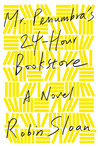
Mr. Penumbra's 24-Hour Bookstore by Robin Sloan: A Review

Mr. Penumbra's 24-Hour BookstoreMr. Penumbra's 24-Hour Bookstore by Robin Sloan
My rating: 4 of 5 stars

This one had me at "24-Hour Bookstore" :) And, indeed, the magic of this book lies in this namesake bookstore itself.

The novel opens with Clay, an unemployed website techie, who finds himself working the late shift at an all-night bookstore in San Francisco. But this is no ordinary bookstore. The shelves are stocked not with ordinary books but bound puzzles (of sorts), and the "customers" aren't customers at all. I won't go into the details so as not to spoil anything. Suffice it to say, that while this book is a clever page-turner that follows Clay on his quest to uncover the secrets of a mysterious book and the underground society dedicated to its preservation and the cracking of its code, it is also an interesting commentary on the place of books in a digital age and the unique possibilities of how this chasm might be bridged.

The only disappointment for me was the rapid-fire ending, as well as the slight let down I felt when the riddle was solved (so much build up, it would have been nearly impossible to fulfill whatever expectations I had). But this book is really fun, and very, very clever.

Friday, November 16, 2012

The Yellow Birds by Kevin Powers: A Review

The Yellow BirdsThe Yellow Birds by Kevin Powers
My rating: 4 of 5 stars

4 1/2 stars. Wow. There is imagery in this small novel about an Iraq war vet that may never leave my memory.

However, anyone looking for a linear "war story" shouldn't bother. This book is messy and complex, even in its simplicity. But it somehow manages to both capture the experience in a hypnotic, poetic, rumination rather than a traditional narrative. This book is chaotic, achingly visceral, and tremendously lyrical in its rendering of war and its aftermath.

I fell in love with THE THINGS THEY CARRIED by Tim O'Brien when I was a student. This novel does what O'Brien did for Vietnam for the war in Iraq. It is no wonder it was nominated for a National Book Award. Gorgeous.

Monday, November 05, 2012

On Hope (Four Years Later)

I'm not entirely sure how it is possible that four years have passed since President Obama was first elected. Already, the memories of that Tuesday have faded for the girls. Only Kicky vaguely recalls being awakened from sleep to hear Obama give his acceptance speech with his wife and two little girls at his side. And neither of them remembers that cold day in January when we watched the inauguration on TV while their dad braved the frigid temperatures and unbelievable crowds on the Mall. Obama's daughters have grown, and so have ours. Four years is a long time in the life of a child, but not so long in the life of a man. And especially a man with such a big job to do.

I don't know what will happen tomorrow. No one really does. Because no matter what any polls suggest right now, uncertainty is the only certainty. What I do know is this: four years ago, everything was in turmoil. Everything was precarious. The housing market had crashed, the economy had crashed, people were despairing everywhere. Obama offered hope, and while the ascension from those seemingly bottomless depths has been slow, the climb has been a steady one. And it is hope that sustained us.

This campaign has been endless and ugly. I truly fear for the future. I fear a backsliding, an undoing of all the good that has been done. I worry about my rights as a woman and the rights of my daughters to govern their own bodies and to love whomever it is they choose to love. I worry about the earth's health, and the health of all the people on it. I need hope that our movement as a country, as people, will be forward.

Below is the letter I wrote to the girls so they might never forget the importance of that historic moment. And lest I ever forget the pride, the excitement, and, most importantly, the hope I felt for my country that day just over four years ago:

January 19, 2009

Dear Kicky and Esmée,

I just put you down to sleep after a long day off from work and school. Your Daddy is at the theatre at one of the inauguration events, and I am here, listening to the sounds of the house as you fall asleep.

I know you both understand what is happening tomorrow, though I also know you are too little still to understand how very important this day is. Your father and I debated for a long time about whether or not we should take you down to the Mall to witness the swearing in of our 44th president, Mr. Barack Obama. And it was with a heavy heart, and more than a little hesitation, that I finally told your father to accept the ticket that had been offered to him and made the decision that we girls would stay home to watch Obama address this nation as President for the very first time.

On the news, the streets that we drive every day are filled with people. There is a line trailing two blocks long out of Ben’s Chili Bowl on U Street. The Mall is crawling with people who will sleep in the cold all night just to be closer to him tomorrow. Esmée, when you go to school on Wednesday, you will be only blocks away from where the Obama girls eat and play and sleep. People have traveled here (our home, the place where we live!) from all over this country, all over this world, just to take part in this moment in history.

I can’t help but worry that I am depriving you of an experience of a lifetime, that some day I may truly wish I had risked the crowds and suffered the cold with you, so that you could also be a part of history. That this will be one of my big regrets. We live so close. We could almost walk. But I only want you warm and safe. And as your mommy, that trumps everything, right?

What I need to remind myself is that you are a part of this moment in history. You, my two bright eyed, curly-haired angels, are Martin Luther King Jr.’s dream realized. You too are products of the civil rights struggle which has ultimately led to this moment. You too are proof that this world can change.

Your grandfather, who passed away before you were born, was a young man back when Rosa Parks sat in the front of the bus. Around the same time he was one of the first black lifeguards at an all white east coast beach. When he proposed to your Nonna (and she said yes) it was with the understanding that they might both lose their jobs. That their love for each other would threaten friendships and family ties. They risked everything to be together. And the result was more than twenty-five years of marriage, your Auntie B, and your Daddy.

And, thankfully, their courage, and the courage of countless others was not in vain. By the time your father and I fell in love, the world had shifted on its axis. Changed.

Now, when I look around your classrooms at the myriad of colors (at the faces in all their beautiful shades of brown and peach and cream), my heart thrills at your curiosity about each others' differences and your simultaneous ability to transcend them. You are dumbfounded by our fascination with this, can’t understand why a brown-skinned man in the White House is such an anomaly. You are seemingly incapable of prejudice. Racial bias is, at least for now, a bitter relic of your ancestors’ pasts.

Tomorrow, we will watch our future unfold on TV, safe and warm inside. You may or may not remember the details of this day, but I will try to remember them for you.

Whether we are there or not, you are a part of history, little ones. You are the proof. Yes we can, he says. And I believe -- I have to believe for you -- he is telling the truth.

On this day and every day, I love you…to the bottom of the ocean and back to the top,

Mommy

Thursday, October 25, 2012

On Envy

Envy is bad. I tell my girls all the time what an ugly thing it is. It's petty. It's selfish. And more than anything it shows a lack of self-confidence, a fundamental chip in one's armor. To envy is to admit that someone else has something you don't have, and worse, can't. Then why, as a writer, do I find myself feeling so damned bitter so much of the damned time? Why am I even ashamed a little to write this post?

Maybe it's just that it's that time of the year. It's fall, when all of the publishers' biggest hitters come to bat; it's also when all the major book awards are given out, seemingly to the same handful of people.  (I'm sorry, but if I have to read another essay about Junot Diaz's genius, I might shoot myself.) All of this seeming to prove that, contrary to what some argue, there is a limited amount of love for writers. And some of them hog it all up. We are, whether we like it or not, engaged in a competitive sport: competing for attention, review space, prizes.

I am "friends" with a lot of writers on Facebook, and in real life many of them are, indeed, friends. And I can honestly say that it is not envy but happiness I feel when one of them is on a roll. I have squealed with delight at their publishing news, their good reviews. And I'll be the first one to spread the word. But for some of those I've never met face to face (or met and didn't really like all that much) I find myself sighing and wishing their good fortune was my own. That I were able to post fifteen different glowing reviews of my latest book, transcriptions of the gushing interviews, photos of the magazine spreads.

Envy makes me feel self-righteous (another ugly trait). I am the hardest working girl in the book business, I tell myself. I'm under-appreciated. They'll miss me when I'm gone.  -- all of which makes me feel better for about thirty seconds. And then I feel sick. Self-loathing almost always follows a good flirtation with envy. It's like drinking too much. You know it's bad, that tomorrow you'll feel awful, but still you indulge.

But the worst part is that it's paralyzing. When I am feeling this way, I am incapable of putting pen to paper. Everything I write sounds like shit. I second guess every word, every metaphor, everything. Envy makes me a bad writer and worse, a hypocrite. I don't ever want my daughters to begrudge anyone anything, or to feel that they are lesser people for simple lack of recognition.

And so I am vowing right now to put a kibosh on the envy. I'm going to hide those Facebook posts so I won't even be tempted. I'm going to let it go. Because I am the hardest working girl in the book business, and now it's time to get back to work.

Sunday, October 21, 2012

All About Lu-Lu by Jonathan Evison: A Review

All About LuluAll About Lulu by Jonathan Evison
My rating: 3 of 5 stars

3 1/2 stars. What I loved about The Revised Fundamentals of Caregiving, I also loved about this, Evison's first, novel: the quirky characters, the humor, and, ultimately, the underlying sense of sorrow and less. It did feel more muted in this freshman effort though...Evison has clearly grown as a writer.

This is the story of Will Miller, vegetarian son of bodybuilding and meat-eating Will Miller, Sr. Overestimated his whole life, he is wracked with a sense of unfulfilled promise. Enter Lu-Lu. After Will's mother dies, and Will Sr. remarries, his new step-sister, Lu-Lu, enters his life and suddenly gives him a true sense of purpose.

However, over time Lu-Lu begins to change, pulling farther and farther away from Will. His longing for her, and the pain of her evasion is acute.

The book was sort of like a cross between a John Irving novel (with its colorful cast of misfits) and Endless Love by Scott Spencer (unrequited teenaged love at its best). The twist at the end was a little predictable, but overall it was a fun and engaging read.

Wednesday, October 17, 2012

It's Like Pulling Teeth

My girls, while sharing many, many similarities do exhibit one stark and striking difference: the way in which they handle a loose tooth.

Esmee is one of those kids who just leaves it alone. The roots start to dissolve, the tooth gets wiggly, and she waits. And waits, and waits. Until the thing is spinning around, hanging by a thread, disrupting her speaking and eating. And then, just when I don't think I can even stand to look at her adorable face anymore (disfigured as it is by this dangling tooth), she gives it the one little tug that sets it free. I suspect she'll be one of those teenagers that leaves her zits alone too. That never waits by the phone for a boy to call. I am in awe of her patience, her nearly zen-like stoicism, the way she just lets the chips fall as they may. Maybe because I have never, ever shared that type of restraint, that magical self-control. And neither has her sister.

When Kicky was about seven years old, we had a party at our house. It was mostly guys. We ordered a Wrestlemania event on pay-per-view (don't ask), and barbequed. The kids were amped up. They both love an audience, and this was a captive one. At this point Kicky had lost several teeth, including one of her top front ones. The other one was just starting to wiggle. But for whatever reason, she became convinced that she was going to lose the tooth that night. And over the course of the next several hours she made it happen. Blame it on the testosterone, or the spectacle that is Wrestlemania, but the girl was determined. And with the next body-slam, she yanked that tooth out by the roots and held it up, in all its bloody glory for us to see. Her pride. Her prize.

I like to think of her as pro-active, of one who takes initiative, of a girl who knows what she wants and isn't afraid to go get it. Like me. (I remember distinctly kneeling on the pedestal sink for hours, face pressed against the mirror, as I wriggled and wriggled my own teeth prematurely from their own comfortable sockets.) But what I'm finding is that this personality trait Kicky and I share is a positive attribute in some circumstances, but not so great in others. (I see ravaged blemishes, and nights spent lamenting the silent phone in her teenaged future, and it breaks my heart.)

Soliciting her father's help.


And as for me?

I have been working on the new book now for over a month. And it's been agonizing. I write 5000 words, delete 5000 words. I create a character and then wipe them off the face of my fictional universe. I think I know where I'm going and then I'm lost, up to my knees in proverbial verbal quicksand. I wake up every morning wondering what will go wrong next. The last book didn't give me grief like this. It was easy, breezy. I dare say it wrote itself...seriously, I showed up to do the typing but the story emerged without resistance.

This one, though? It's that just-barely loose tooth. It's not ready. It would probably benefit from Esmee's graceful forbearance. I admire the writers who languish, who wait months, years, for the story to come. For the patient ones. But I'm like a seven year old at a Wrestlemania party, and I am dying to yank that sucker out by the roots. No guts, no glory...right, Kick?

Saturday, October 06, 2012

The Financial Lives of the Poets by Jess Walter: A Review

The Financial Lives of the PoetsThe Financial Lives of the Poets by Jess Walter
My rating: 4 of 5 stars

I loved Beautiful Ruins (one of my favorite books of the summer), and Walter's backlist (thus far) does not disappoint.

This book should be depressing, but it's not. Who would have thought that a book set during the country's descent into The Great Recession could be laugh-out-loud funny? I was pretty skeptical.

Matt (our hero) is a former business reporter who gave up his job to pursue his dream of creating a website dedicated to business news given in poetic form (poetfolio.com). However, the website never got off the ground, and after returning to his job, the economy bottomed out and he was laid off. The housing market also crashed, and jobless, he was talked into filing for forbearance. We meet Matt, our hero, six days before he will lose his house if he is unable to come up with a $31,000 balloon payment (and with $9,400 to his name). In addition to these dire financial straits, his wife has begun an online flirtation with an old flame. On the precipice of homelessness, financial ruin, and losing his wife to a guy named Chuck, Matt goes out to the 7-11 one night for milk and meets his destiny...in the form of two drug dealers.

I'll let you experience the rest of this one on your own. You'll be glad you did.

While Beautiful Ruins had greater depth...this novel is equally riveting and heart-breaking and funny. Walter's characters are just terrific.

Friday, October 05, 2012

On How I Wish I Could Write Funny

I have a pretty good sense of humor. I crack jokes. I'm fairly quick witted. But when it comes to writing, I can't write funny to save my life.

I know some people don't read me, because my subject matter is almost always serious. I like the underbelly of things. I tend to dig into the deep dark places and set up camp there. I get it; my books are not beachy sort of reads. And yet other people are drawn to those dark recesses, moths flirting with flames.

But I love humorous writing, and I really wish I could do it well without sacrificing the larger intent of my work. Maybe it's because I've been reading a couple of those sorts of books lately -- the first being The Revised Fundamentals of Caregiving by Jonathan Evison (you can see my review here). It's brilliant in its ability to both make you laugh and crush your heart at the same time. So too, am I finding The Financial Lives of the Poets by Jess Walter. On the surface, it's about a guy who has lost his job and is about to lose both his house and his wife. Pretty grim stuff. But it's hysterical. I have seriously guffawed in public over this book.

I want to write that kind of book someday. I want to write "The Little Miss Sunshine" of books.

I don't know whether I am articulating this because I have any intention of doing it NOW...in this book, the one with the bridges and the taxidermied animals and the hurricane. Or if it's just some vague goal.

After the big changes I recently began to implement, my book is shrinking. I am losing thousands of words a day even as it begins to really gel together. Do you know what that feels like? It feels like crap. It feels like the opposite of progress. And then this drunk female reporter shows up the other day, and I don't know whether she belongs in this book or not. But she's funny. She's really funny, and I wonder if she deserves any of these new words.

With every novel I try to challenge myself in some way (whether in terms of point of view, or plot, or style). But I just don't know if this is the book where I write funny or not.

What do you think?

Monday, October 01, 2012

First Drafts and Other Dirty Little Secrets

The other day I read something about an author who is allowing readers to watch her novel-writing process via Google Docs. That's one ballsy lady, I thought. I could never imagine allowing anyone access to my false starts, my flailing, my failures. My first drafts are ugly little things. Really, truly homely. Every single one of them begins like an awkward adolescent with bad skin and bad posture and a bad haircut. You, the reader, don't see them until they've somehow survived that awkward phase and bloomed into the pretty and smart things they were destined to be.

I kind of love the illusion that my novels come out fully formed, my prose lovely, and my characters fleshy and real. But this illusion is a dangerous thing as well, because it says to beginning writers that first drafts are something to be ashamed of. That they are something that writer's shouldn't talk about, shouldn't share, shouldn't even become too attached to.

I am a teacher as well as a writer, and I feel as though I am constantly trying to relay the notion that writing is a process -- and even that one should stand back and look at entire books as just part of the larger process of making a writing life. But that's a hard point to drive home, when what I typically offer of my own work is what's on the pages of already published novels. They aren't the crappy paragraphs riddled with cliches and flat characters. They aren't the rambling pages of exposition, of stilted dialogue, of clumsy descriptions.

So...while I am not yet ready to bare all, (boy, the Queen would have loved me), I am willing to share a bit of the clunky business of drafting a novel. That was part of the whole point of this blog to begin with, wasn't it?

Anyway...as of October 1, 2012 (that's today), here is where I am with my novel. I changed my mind about something huge. I had to nix my 86 year old agoraphobe. She just doesn't belong in this book. Every morning for two weeks I have woken up at 4 a.m. wracking my brain my as to why I couldn't seem to decided what was going to happen next. (I sort of ran out of steam after the first 10,000 words...and started wondering if maybe this whole thing was just another terrible idea.) And then it dawned on me that all that fear and anxiety she was feeling, that need to closet herself away really belongs to my narrator's mother instead.

A few days ago, I began to hear this strangely hypnotic voice that, I think, will open the book as a sort of prologue...but keeping it means losing the old lady. I have no choice.

Other things that happened this week? I have researched Nascar, taxidermy, and bridges. So much about bridges. And yesterday, I finally got my opening chapter written. What if a boy is sent to live with his agoraphobic mom for two weeks while his amputee Dad and uncle drive to Daytona after winning a ride in the pace car? We'll see. And I'll keep you posted. Here.

Thursday, September 27, 2012

The Revised Fundamentals of Caregiving by Jonathan Evison: A Review

The Revised Fundamentals of CaregivingThe Revised Fundamentals of Caregiving by Jonathan Evison
My rating: 4 of 5 stars

Last night while I was lying in bed finishing this book (which I had initially recommended to my husband), I shook my head and said, "Nope. You shouldn't read this one." "Why?" he asked. "It will break your heart," I said. "In half."

THE REVISED FUNDAMENTALS OF CAREGIVING (which is one of the best titles ever in the history of titles) is the story of Benjamin Benjamin, a man who has suffered an unthinkable tragedy and, in the wake of the disaster, is charged with caring for a young man named Trevor who suffers from Muscular Dystrophy. A real light-hearted beach read, right?

But surprisingly, Evison is able to bring humor to this story of two men who find hope in each other. I found myself laughing long before it made me cry.

It's a road trip novel filled with colorful characters. It's got a little love story too. Some of the action felt a little over-the-top (car chases, lots of physical comedy), but I forgive these small weaknesses because by the end of the novel I truly cared about both Ben and Trevor. And it broke my heart. In half. Luckily, unlike my husband, I enjoy that sort of thing.

Tuesday, September 25, 2012

Breathing Water: A Retrospective

1999 was an amazing year. At the end of my life, I still suspect I will look back at that year with equal parts wonder, nostalgia, and pride. I got married in 1999. I turned 30. I received a $10,000 grant from the Sherwood Anderson Foundation immediately after being laid off from the job I had entering airline award rules into a database for a website that no longer exists. And my first novel, Breathing Water, was published.

Breathing Water was not really my first novel. It was actually my third. In college I wrote a book called Tygers and Berries: A Modern Inferno (don't ask, please don't ask). In graduate school I wrote a novel which ultimately became Paper Rain. (You can see the post about this one here.) But Breathing Water was the first novel to be published, to find a real audience. And I was over the moon.

I remember going to our local Barnes and Noble and seeing a stack of them on the front table and almost passing out. I wish there was a word for that feeling, but there just isn't.

My publisher didn't send me on tour, but I fashioned a tour myself, traveling around Vermont with my Dad, visiting all of the local bookstores where I happily sat signing books for anyone who would have me.


Me at my very first book signing.

I remember feeling both thrilled and exposed by the novel. Knowing that there were five thousand copies (!) out there in the world was both exciting and terrifying. What would people think? Of Effie (who was so very much like me at the time). Of my writing? What if people hated it? What if it was all a fluke, or worse some cruel sort of joke?

Then when the review came out in The New York Times, I was pretty sure I was on the fast track to literary fame and fortune. (My grandfather posted copies of the review all over my hometown in Vermont -- including on the bulletin board at the boat access area at the pond which serves as inspiration for Lake Gormlaith. He also purchased a dozen copies which he distributed to all of the local libraries, slipping a copy of the review inside each one.)

Who would have known that just five years later, Breathing Water, as well as my second and third novels would be out of print? That I'd be working as an admin assistant at an IT company. That I would be so busy with two babies I barely had time to think, never mind to write. And that when I finally did manage to finish my fourth novel, no one in the world would want it. That I was damaged goods. Having three novels out of print made me an untouchable in publishing, though no one would admit that was the reason for rejection.

The grant money was long gone (as well as money from the NEA which allowed me to finish Two Rivers). Breathing Water had been remaindered, that luminous blue cover labeled with Discounted stickers wherever books were sold. All those gifts from 1999 were gone. Though luckily, the husband stuck.

It felt like a death. Of course, the grief was smaller, the sorrow just a sliver of true sorrow. But it truly felt like a dream had died.

The years that followed were difficult, though filled with so many other blisses: my daughters, a cross-country move/adventure, many years of teaching, and more writing. Because while the dream of fame and fortune (of further publication even) might have been dead on the vine, the need to write was not. And the simple act of writing, of working and creating was what drove me. I had to trust that if I continued to write my heart on the page that someday someone would love those pages back.

Of course, most of you know the rest of the story. Two Rivers finally found its home with Kensington (as did the the subsequent four novels). And even better, Kensington bought my backlist and has systematically revived them - one by one, year by year, ending with the re-release of Breathing Water. Today.

Today is the first day in a decade that every single one of my books is in print. And while nothing compares to that moment when I stood looking at my books perched on the front table at Barnes and Noble for the first time, this feeling comes pretty damn close.

Monday, September 24, 2012

When One Idea Usurps Another

Here's what happened:

I wrote the first thirty pages of a new book. I listened as the characters started to tell me their stories. I got excited about them. They started to breathe. I came up with a title. I even made a Pinterest page where I gathered images to inspire. And then I signed a contract with my publisher for three new books...this would be the first.

But then we went to Vermont (where the novel is set), and the voices got softer. Farther away instead of closer. I was looking everywhere for the story, but it was playing an elaborate game of hide-n-seek with me. Still, I didn't fret. I enjoyed time away from writing and with my family. I read lots and lots of wonderful books. I walked in the woods. I basked in the sun. I ate a lot. I looked at the pond.

Then, one day as we were driving into town from our camp, I saw a trailer that I had never noticed before, spray-painted: NO TRESPASSING, NONE! GAURD [sic] DOGS 24 7. That's right. Someone spray-painted their house in order to keep trespassers out. There were also signs nailed to the trees by the house, bearing the same warnings (but in fluorescent orange instead of white Rustoleum). What also happened during our trip back east was that we went to visit family in Massachusetts and went on a tour of Emily Dickinson's house. I started thinking about agoraphobia and the solace of home, the safety of home. The sanctity of home. Contributing to this, we had a minor mishap with our rental house (our old house in Maryland) which got me thinking a lot about privacy and property and home ownership. This summer we also lost my grandmother, which both muddied and clarified all sorts of things. Anyway, all of a sudden there were new voices whispering in my ear, saying, Listen to my story.

We came back from Vermont and determined to return to the original idea. I figured I'd been on vacation, so maybe these characters had too. But to no avail. It's kind of like love...you can't make someone love you back. And Rain and Vivi are playing hard to get. Or maybe they're just letting these new characters have this dance.

So what next? Next I listen. I listen to R.J. as he tells me about his obsession with bridges. I listen to Sylvie as she describes her life confined inside her 500 square foot home. I wait for the hurricane that is creeping up the coast.

And then when this song is over, I'll go back to the corner where I hope the others are sitting patiently waiting and I'll see if they are ready to dance.

Thursday, September 20, 2012

The Salt God's Daughter by Ilie Ruby: A Review

The Salt God's DaughterThe Salt God's Daughter by Ilie Ruby
My rating: 4 of 5 stars

Ruby's THE SALT GOD'S DAUGHTER reads like an extended dream, this novel unlike anything else I've ever read. This story is written in a language somewhere between poetry and prose, about a world somewhere between reality and fantasy, and the characters somehow between human and mythological.

The story of three generations of women, it is also about motherhood and nature and the cruelties of humankind. Set in southern California primarily in 1970s and 1980s, most of the novel is dedicated to Ruth, the daughter of a bohemian mother who fails her daughters at seemingly every turn. But it also offers us Naida, Ruth's daughter. I found Naida to be the most endearing character, and my heart ached for her as she struggled to free herself from her own heredity and history.

It took me forever to read this simply because I wanted to linger over certain sentences. The lyricism reminded me in many ways of WE, THE ANIMALS by Justin Torres; the prose was so lush and rich.


Wednesday, August 15, 2012

The Art of Fielding by Chad Harbach: A Review

The Art of FieldingThe Art of Fielding by Chad Harbach
My rating: 4 of 5 stars

Here is further evidence (as if I needed it) that I need to relinquish my stubborn reluctance to pick up certain books.

The Art of Fielding, despite being about baseball (i.e. the slowest, most boring sport in the universe) and college boys (also some of the slowest and most boring things in the universe), was exactly the kind of novel that I love.

Henry Skrimshander begins his promising career as a shortstop at Westish College under the tutelage of classmate Mike Schwartz, but one ill-fated throw shatters his zen-like composure on the field and threatens his entire future. The novel follows Henry and Mike as well as the small college's president, Guert Affenlight and his prodigal son of a daughter, Pelly.

The story is sprawling in scope and crawling with quirky characters in the way that John Irving and Michael Chabon's novels are. (It did, at times, echo A Prayer for Owen Meany just a little too closely – though Irving himself endorsed the novel with a dust jacket blurb, so apparently he was okay with the similarities, so why shouldn't I be?)

It wasn't perfect, and the end wasn't the home run (ha ha) that I hoped for, but it was fun and I will definitely read Harbach's sophomore effort.

Friday, August 10, 2012

The Chaperone by Laura Moriarty: A Review

The ChaperoneThe Chaperone by Laura Moriarty
My rating: 3 of 5 stars

3 1/2 stars.

The premise of this novel is terrific: the story of one summer in the life of silent film star Louise Brooks and her chaperone, Cora. Cora is a likeable and compelling character. An orphan who has made a life for herself in Wichita, she is seeking answers to the questions of her parentage and early years and embraces an opportunity to return to New York City as a chaperone to a fifteen year old Louise Brooks who has been invited to study dance there for the summer.

I thoroughly enjoyed the story of the summer these two very different women spent together -- Cora seeking her past, and Louise chasing her future. Moriarty does a fabulous job of rendering these two characters and painting New York City in the twenties; I was absolutely captivated by both the characters and the setting.

However, I felt like narrative didn't have anywhere to go after this pivotal summer, and Moriarty winds up leading us through the subsequent years in these women's lives at breakneck speed, summarizing the consequences of this turning point in each of their lives in a way that made me feel distanced from each of them. I think Moriarty strives to make this a story about Cora's search for identity, but ultimately the ending feels too pat, and a bit contrived.

Still, the prose is lovely and the characters and setting are magical at times. Definitely worth the read.